
Star Sapphire and Star Ruby: How to Judge a Star
A star sapphire or star ruby shows a glowing star from tiny needle inclusions. Learn how asterism works, how to judge a star, how to spot synthetic stars and how to care for one.
On this page
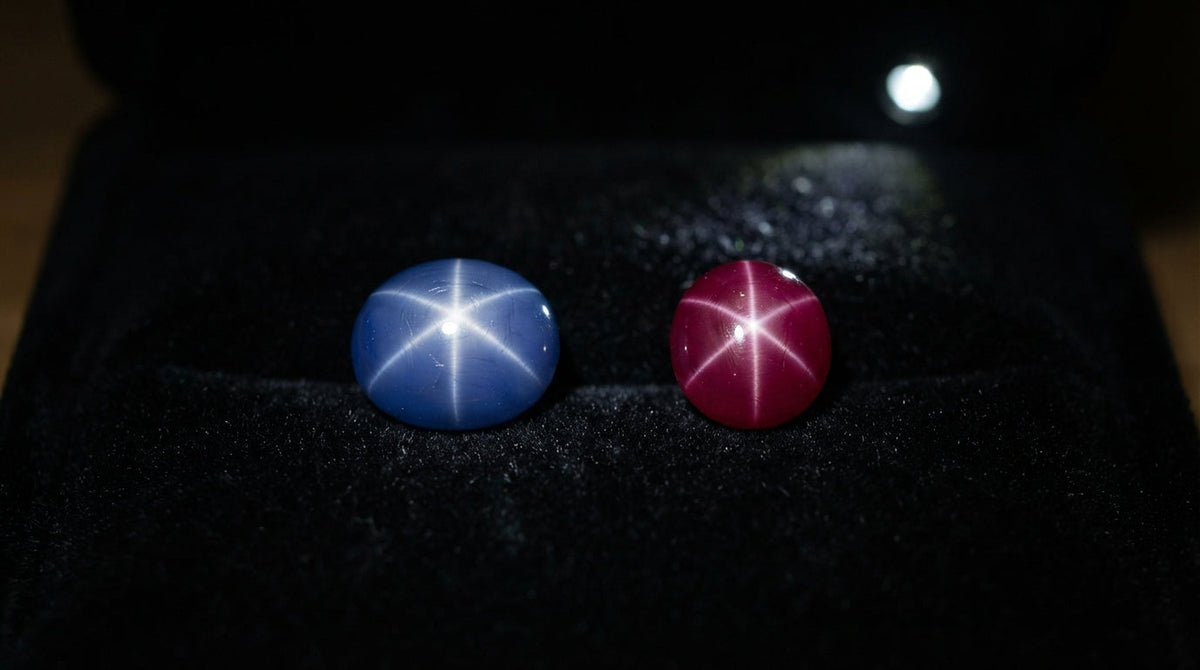
A star sapphire is a sapphire that shows a glowing six-ray star across its domed surface when light hits it. Star rubies show the same effect in red. A good star is sharp, centred and glides smoothly as you move the light, and it sits on a stone with attractive body colour.
Here is how the star forms, how to judge one, and how to avoid synthetic and treated stars.
What makes a star: asterism explained
The star effect is called asterism. It comes from very fine needles of rutile, a titanium mineral, growing inside the sapphire. Gem dealers call these needles "silk".
- Three directions: the needles line up in three directions, 60 degrees apart, following the crystal's six-sided structure.
- Light bands: each set of needles reflects light into a bright line running across it.
- Six rays: three lines crossing in the middle give six rays.
You can read more about the science on Wikipedia's asterism page. Ruby and sapphire are both corundum, so star rubies work the same way.
Why star stones are cut as cabochons
Stars only show on a smooth, domed surface. That style is called a cabochon. A faceted cut would break the light into sparkle and hide the star.
- Orientation: the cutter lines up the base with the needles so the star sits in the centre.
- Dome height: a dome that is too flat gives a weak star. One that is too high can make the rays short and crowded.
- Heavy bases: some stones keep a thick base to save weight. Look at the side profile, because you pay for that hidden weight.
See our cabochon collection to compare dome shapes side by side.
Six-ray vs twelve-ray stars
Most star sapphires show six rays. A few show twelve. This happens when two different sets of needles, often rutile plus hematite or ilmenite, cross at about 30 degrees to each other.
Twelve-ray stars are seen mainly in some black and very dark sapphires. The Smithsonian holds a 12-ray dark blue star sapphire from Sri Lanka as an example.
Ray count is interesting, but a sharp six-ray star on good colour is worth more than a blurry twelve-ray one.
Star sapphire vs star ruby
| Type | Body colour | Star | What to know |
|---|---|---|---|
| Blue star sapphire | Grey-blue to rich blue | Usually white or silvery | The classic; richer blue with a sharp star is the goal |
| Black star sapphire | Very dark brown-black | Often golden or silvery | More affordable; the star is often very clear |
| Star ruby | Pink-red to red | White to silvery | Fine red with a good star is rare; many low-cost stones are opaque and purplish |
| Other colours | Pink, purple, grey, yellow | White to silvery | Less common; judged on the same points |
Browse real examples in our star sapphire and star ruby collections.
How to judge a star sapphire
- Use the right light. A single point of light, like a phone torch or direct sun, shows the star best. Soft office lighting can hide it.
- Check sharpness. Good rays are thin and crisp, not wide and fuzzy.
- Check the legs. All rays should be straight, similar in strength and reach down towards the edge.
- Check centring. With the stone sitting flat, the star should meet at the top of the dome.
- Move the light. The star should glide smoothly across the surface. This is called mobility.
- Judge the body colour. This is the biggest value factor. Rich blue or red beats grey or dull brown.
- Look for some translucency. A stone that lets a little light through glows. Very clear stones rarely have strong stars, because the star needs silk.
- Check the shape. The dome should be even, the outline neat and the base not too heavy.
What drives the price
- Body colour and how attractive it is.
- Star quality: sharpness, centring and mobility.
- Translucency and clarity, including visible cracks.
- Size and weight, with fair proportions.
- Natural and untreated status, confirmed by a lab report.
Synthetic, treated and fake stars
Synthetic stars (Linde and similar)
Lab-grown star sapphires and rubies have been made for decades. The best-known brand is Linde. They are real corundum, but not natural.
- Too perfect: the star is very sharp and looks almost painted on.
- Even colour: the body colour is very uniform, often with a milky look.
- Under magnification: curved growth lines and round gas bubbles point to lab-grown.
- Marks: some older Linde stones carry a small "L" on the base.
Diffused stars
Some stones have titanium diffused into the surface and are then heated to grow a star in a thin outer layer. The star looks very strong and sits right on top. Re-polishing can remove it. A lab can identify this.
Heat and star stones
High heat dissolves rutile silk, which removes the star. So natural star stones are usually not heated at high temperatures. Still, ask about treatment and read the report.
Dyed, filled and scratched imitations
- Dye and fillers: some low-cost star rubies have dye or fillers in their cracks. Colour packed into cracks is a warning sign.
- Scratched backs: some imitations are glass or quartz with fine lines scratched on the base to fake a star. Turn the stone over and look.
Our guides to synthetic vs natural sapphires and synthetic vs natural rubies go deeper. For any important star stone, ask for a lab report. At Raza Gems we show the report on major stones.
A famous example
The Star of India is one of the best-known star sapphires. It is a Sri Lankan stone of more than 500 carats, on display at the American Museum of Natural History in New York. In some traditions, star sapphires are believed to bring guidance and protection, but these are beliefs, not proven effects.
Caring for star sapphire and star ruby
- Hardness: corundum scores 9 on the Mohs scale, so it suits everyday rings.
- Settings: a bezel or strong prongs protect the dome and edges.
- Cleaning: use warm water, mild soap and a soft brush.
- Avoid ultrasonic cleaners on stones with cracks, fillers or dye.
- Storage: keep it in a soft pouch, away from diamonds and other hard gems.
- Light scratches: after years of wear, a dome can be re-polished by a skilled cutter.
FAQs
Are star sapphires valuable?
They can be. A natural star sapphire with rich colour and a sharp, centred star is rare and prized. Greyish or opaque stones with weak stars cost much less.
How can I tell if a star sapphire is real?
Natural stars are usually slightly imperfect, with some variation in colour. A star that looks painted on, with flawless even colour, suggests lab-grown. A lab report is the only sure answer.
Why can't I see the star in my stone?
You probably need a single strong light, such as a torch or direct sun. Soft, spread-out light hides the star. A poorly oriented cut can also push the star off-centre.
Is a twelve-ray star worth more than a six-ray star?
Not automatically. Twelve-ray stars are rarer and interesting to collectors. But body colour and star sharpness still decide most of the value.
Can I wear a star sapphire every day?
Yes. It is very hard and handles daily wear well. Choose a protective setting and avoid hard knocks on the dome.
Keep reading


Ready to find your stone?
Natural gemstones and jewellery from our Dubai showrooms, shipped worldwide with tracking.