
Labradorite Stone Meaning, Beliefs, Price and Cautions

On this page
Labradorite stone is a natural feldspar gem that looks dark grey until the light hits it. Then it flashes electric blue, teal, green, gold and sometimes violet or orange. That flash is called labradorescence, and it lives inside the stone. It is not a coating or a treatment.
Below we cover what labradorite is, how it forms, its meaning and chakra links, price, how to wear and care for it, and the side effects people ask about. You can see real stones in our labradorite collection.
What Is Labradorite Stone?
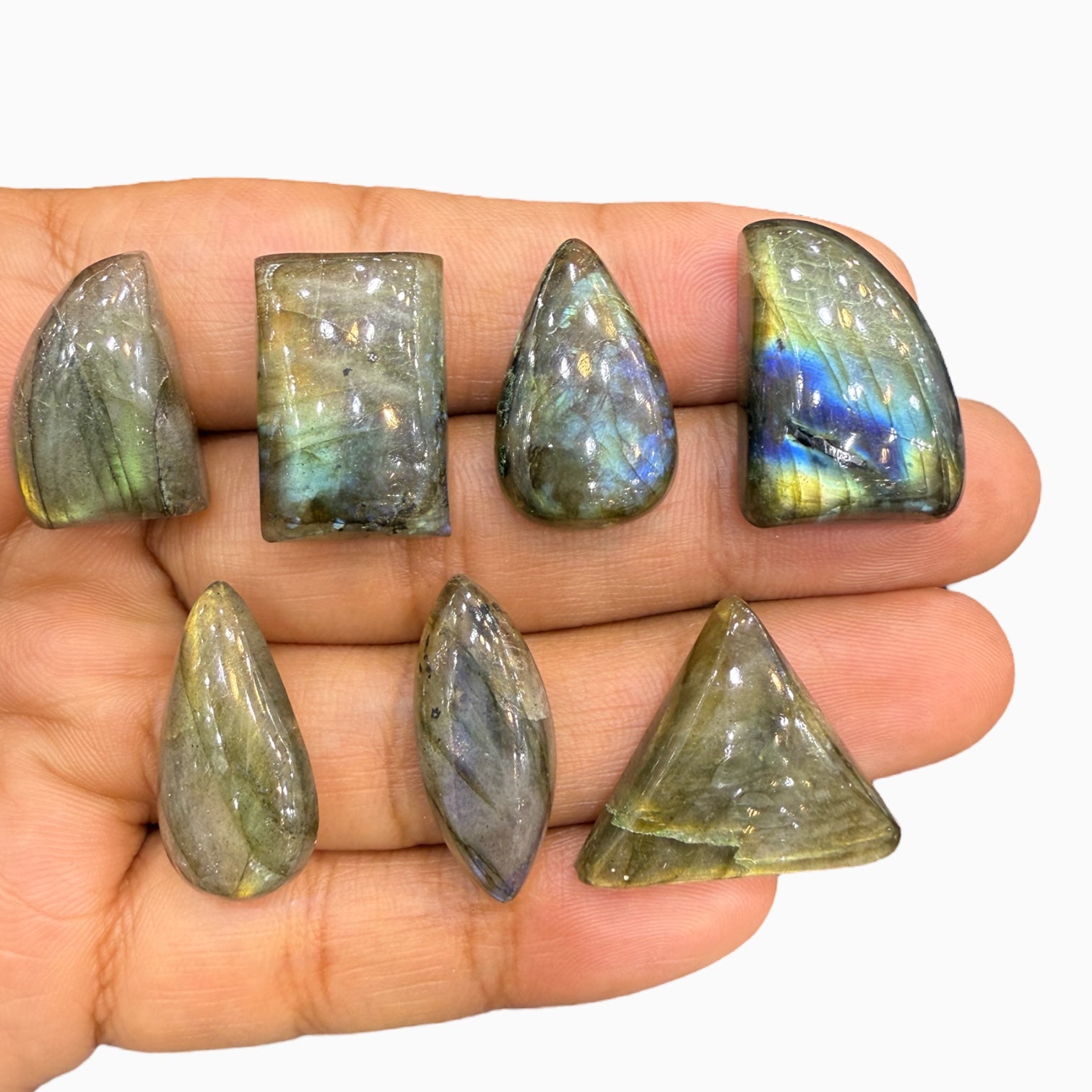
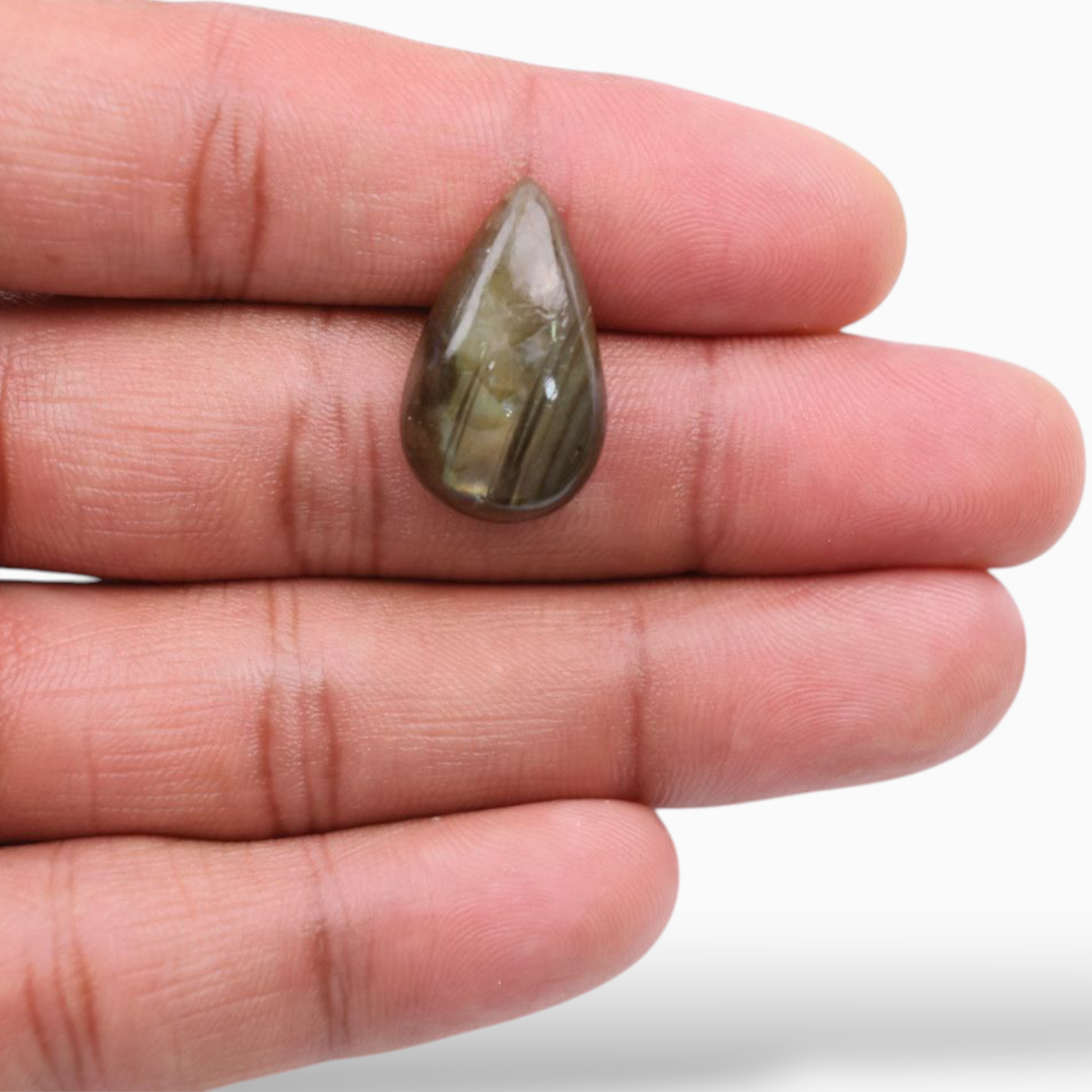
A feldspar mineral. Labradorite belongs to the plagioclase feldspar group. This family of minerals makes up some of the most common rocks in the earth's crust. What sets labradorite apart is its colour flash.
A dark base colour. The body of the stone is usually grey, smoky grey, grey-green or greyish-black. In flat light it can look quite plain.
Where the flash comes from. Inside the stone are very thin, alternating layers of two slightly different feldspars. Light bounces between these layers, so some colours get stronger and others cancel out. This is called thin-film interference.
Natural and permanent. The flash is part of the stone's structure, so it never wears off. Every stone shows it a little differently, and you have to tilt the stone to see it move.
Is labradorite a stone or a crystal?
It is both, and a gemstone too. Whichever word you use, you're right.
- A mineral: it grows naturally inside the earth's crust.
- A crystal: its tiny parts are arranged in a neat, repeating pattern.
- A gemstone: once it is cut and polished for jewellery.
How hard is labradorite?
About 6 to 6.5 on the Mohs scale. The scale runs from 1 (soft as chalk) to 10 (diamond). So labradorite is hard enough for jewellery, but softer than quartz, topaz or sapphire.
What that means for you: don't drop it on hard floors, and keep it away from harder stones like diamond and sapphire, which can scratch it.
How Labradorite Forms and Where It Is Found
Born from magma. Labradorite grows in igneous rocks, which form when magma cools and hardens. As it cools slowly, different minerals crystallise at different temperatures.
The right recipe. Labradorite crystals grow when temperature, pressure and chemistry line up, especially the right balance of calcium and sodium. The thin inner layers that cause the flash form during this slow cooling.
Its rock companions. It is commonly found in basalt, gabbro and anorthosite. Quartz, other feldspars and darker (mafic) minerals often sit alongside it.
How long does labradorite take to form, and how old is it?
A very long time. The cooling and layering of magma can take millions of years. Most labradorite is found in rocks that are hundreds of millions of years old, so the stone in your hand is truly ancient.
Where does labradorite come from?
Named after Labrador, Canada. It was first described by scientists in 1770, from the Isle of Paul in Labrador. The Inuit people of the region knew and used it for generations before that.
Today it is mined in many countries:
- Canada (Labrador): still a major source.
- Madagascar: known for high-quality stones with strong colour play.
- Finland: home of spectrolite, a very colourful type of labradorite.
- Others: Norway, Russia, Australia, India and the United States, including Oregon.
The legend of the frozen Northern Lights
An old Inuit story. Long ago, the Northern Lights were trapped inside the rocks of the Labrador coast. A great warrior struck the rocks with his spear to set them free.
Not all of them escaped. Most of the lights rose into the sky, but some stayed caught in the stone. Those, the story says, are the flashes we see in labradorite today.
Labradorite Colours: From Blue Flash to Spectrolite
When it is not flashing, labradorite is grey or greenish-grey. The flash colours are where the variety comes in:
- Blue: the most common and most classic flash. A deep electric blue is highly valued.
- Teal and green: a vivid, ocean-like blue-green. Very popular in jewellery.
- Gold, yellow and orange: a warm glow seen in better stones. Striking in a pendant.
- Purple, violet and pink: the rarest flash colours and the most wanted by collectors.
- Full spectrum: blue, green, gold and violet all at once. When the full range is very vivid, the stone is often called spectrolite.
Labradorite Stone Meaning
The ideas in the next few sections are cultural beliefs and crystal traditions, shared for interest. They are not proven facts.
The stone of transformation. Crystal lovers see labradorite as a stone for people at a crossroads, facing big changes, new beginnings or the unknown. Its hidden rainbow stands for seeing what you could not see before.
The "veil between worlds". Many traditions tie it to the idea that there is more to life than what we see on the surface. That makes it a favourite for meditation and inner work.
Protection. It is believed to form a shield around the aura that filters out negative energy from people and places. Some describe it as an invisible cloak of light.
Good fortune. In many traditions it is also a stone of luck, happy coincidences and unexpected opportunities.
Labradorite chakra: third eye and crown
Third eye chakra (forehead). This is the centre crystal traditions link with wisdom, imagination and intuition. Wearing labradorite high up, near the head, is said to help you trust your gut and dream bigger.
Crown chakra (top of the head). The highest chakra, linked with spiritual awareness and a sense of connection to everything around you. Labradorite is said to keep this connection clear.
Is labradorite a high vibration stone?
Yes, in crystal traditions. Many crystal lovers call it a high vibration stone, meaning its energy is seen as fast-moving and active. It is thought to encourage change and spiritual growth rather than letting you stay stuck.
Labradorite Stone Benefits (Traditional Beliefs)
These are the benefits most often linked with labradorite in crystal traditions:
- Steady energy and motivation: seen as a gentle, lasting charge rather than a sudden spike. Popular with people who feel drained by work or daily duties.
- A calm, settled mind: many people keep it close as a reminder to slow down, let go of worries and stay present.
- Creativity and new ideas: believed to open the mind to fresh ways of thinking. A favourite for anyone stuck in a creative rut.
- Self-respect and good fortune: linked with luck, new money opportunities, a stronger sense of self-worth and generous behaviour with others.
- Protection from negative energy: its best-known belief. It is especially loved by empaths, sensitive people and anyone in a tense or busy workplace.
- Intuition and inner wisdom: believed to sharpen your gut feeling, so you notice more about people and situations and trust your instincts when making decisions.
Labradorite Stone Price
Labradorite is one of the most affordable eye-catching gems. The price depends mostly on the strength, spread and colours of the flash. A dull stone with a small, weak flash might cost only a few dollars.
Here is a general price guide:
| Quality | Typical price per carat | Best for |
|---|---|---|
| Standard, good blue or teal flash | $4 – $10 | Everyday jewellery |
| Good quality, strong vivid flash | $10 – $25 | Statement pieces |
| High grade, multi-colour flash | $25 – $60 | Fine jewellery and collectors |
| Top-grade full-spectrum spectrolite | $60 – $150+ | Rare collector pieces |
A real example: a good-quality 5-carat labradorite costs roughly $20 to $25. Few other stones give this much colour for the money.
What costs most: a bright flash that covers the whole surface and shows several colours, especially the rare pink or purple.
How to Wear Labradorite Stone
Labradorite looks best on a piece that moves and catches the light.
- Pendants and necklaces: the most popular choice, as a large surface shows off the full flash. Traditions say a pendant keeps its energy close to the body's main energy centre.
- Earrings: drops and studs flash with every turn of the head. Wearing it near the head is said to support the third eye.
- Rings: bold, distinctive statement pieces. Choose a protective setting, as the stone is only moderately hard.
- Bracelets: beads or cabochons give a moving, shifting display that suits daily wear.
- In your pocket: carry a smooth tumbled stone to hold when you want a calm or creative moment.
Who should wear labradorite?
It is seen as a stone that suits most people. Traditionally, it is most recommended for:
- People born in February, March or August.
- The zodiac signs Leo, Scorpio, Sagittarius and Pisces.
- Anyone going through a big life change.
- Empaths and highly sensitive people.
- Artists, writers and anyone who relies on fresh ideas.
- People who meditate or do inner work.
- People in busy, demanding jobs who want a protective stone nearby.
Labradorite for Pisces
A popular match. Pisces (born roughly 19 February to 20 March) is an imaginative, sensitive sign. In astrology traditions, labradorite is said to help Pisces balance their emotions, avoid being swamped by other people's feelings and trust their natural intuition.
Which planet is labradorite linked with?
The Moon. The Moon is tied to intuition, cycles, dreams and hidden knowledge, all things labradorite is linked with. The way the stone suddenly lights up is often compared to the moon lighting up the night sky.
Where to place labradorite at home
- Desk or workspace: for new ideas, creativity and solving tricky problems.
- Main entrance: to shield the whole home from negative energy coming in.
- Shelves and meditation corners: raw slabs, spheres and tumbled stones are used as decor and held during meditation.
How to Cleanse, Charge and Activate Labradorite
Crystal lovers follow a few simple rituals to keep labradorite "working at its best".
How to cleanse labradorite
Cleansing means clearing any energy the stone has picked up from other people or places. Popular methods:
- Water: a quick rinse under cool, clean running water.
- Smoke: pass it through the smoke of natural incense, such as sage or palo santo.
- Sound: place it near a singing bowl or chime while it is played.
- Earth: rest it on or near clean soil for a few hours.
How to charge labradorite
- Moonlight (the favourite): leave it on a windowsill or outside overnight, especially at full moon. Labradorite is tied to the night, so moonlight suits it.
- Sunlight, briefly: a short spell is fine, but don't leave it in strong, direct sun for long.
How to activate labradorite
Activating a stone simply means setting an intention for it.
- Cleanse it first, using one of the methods above.
- Hold it gently in your hand.
- Set your intention. Say quietly what you want, for example "help me be brave and try new things".
- Connect. Look at the flash of colour and focus on it for a moment.
Intention matters. Traditions say labradorite works best when worn with a clear purpose, not just as decoration.
How to Care for Labradorite
- Clean gently: use lukewarm water, a drop of mild soap and a soft cloth. Rinse well and pat dry.
- No machines: avoid ultrasonic and steam cleaners, which can damage the stone's layered structure.
- Keep chemicals away: harsh chemicals, strong soaps and perfume can cloud the surface.
- Take it off for activity: remove it before sport, swimming or housework.
- Handle with care: it can chip if dropped or knocked on a hard surface.
- Store it alone: a soft pouch or padded box, away from harder stones, is ideal.
Does labradorite fade?
The stone won't wear away, but the flash can look duller. Many hours of strong, direct sunlight or heat over time can affect it. Harsh chemicals and perfumes can also cloud the surface, so keep it covered in a soft cloth when you're not wearing it.
Are There Any Side Effects of Labradorite?
The "side effects" people talk about come from crystal traditions, not from science:
- Feeling overwhelmed at first: as a high vibration stone, some very sensitive people say it feels like too much at first. The usual advice is to start with short periods and build up.
- Feelings coming to the surface: some wearers say they feel more emotionally sensitive, as hidden feelings rise. Traditions see this as part of its transforming energy, but it can feel uncomfortable at first.
- Wearing it non-stop: most crystal practitioners suggest taking stones off now and then, so both you and the stone can reset.
The practical side effect is wear and tear. Labradorite is softer than many gems, so scratches and chips are the real risk. A protective setting helps, especially for rings.
FAQs
Can labradorite be worn every day?
Yes, with a little care. Its hardness of 6 to 6.5 suits most jewellery, but choose a protective setting for rings and take it off for sport, swimming and chemicals.
Is labradorite good to keep by the bed?
In crystal traditions, labradorite is linked with a calm mind at night and vivid dreams. Many people keep it on the bedside table or under the pillow, and some say it helps them remember their dreams.
What is the difference between labradorite and moonstone?
Both are feldspars and both show a play of light. Labradorite has a darker body with strong flashes of blue, green and gold. Moonstone is lighter and more see-through, with a softer, floating glow called adularescence. Rainbow moonstone is actually a white labradorite with a blue or multi-colour glow, sold under its own name.
How do I know if my labradorite is real?
Real labradorite flashes only at certain angles, so you have to move it to see the colour. Glass and fakes often show colour from every angle, or a flat, artificial shine. Real stones also feel cool and heavy for their size. For peace of mind, buy from a trusted gem seller and ask for certification.
Gemstone traditions are cultural beliefs, not medical advice. See our gemstone and healing disclaimer.
Keep reading
Ready to find your stone?
Natural gemstones and jewellery from our Dubai showrooms, shipped worldwide with tracking.