

Red coral stone benefits, in Vedic astrology and folk tradition, are all about courage, energy and protection. Red coral is called Moonga in Hindi and Marjan in Urdu, and it is linked with Mars, so it is most often suggested for Aries and Scorpio.
Most natural coral sells for roughly $30 to $300 per carat. Deep red Italian coral sits at the top of that range.
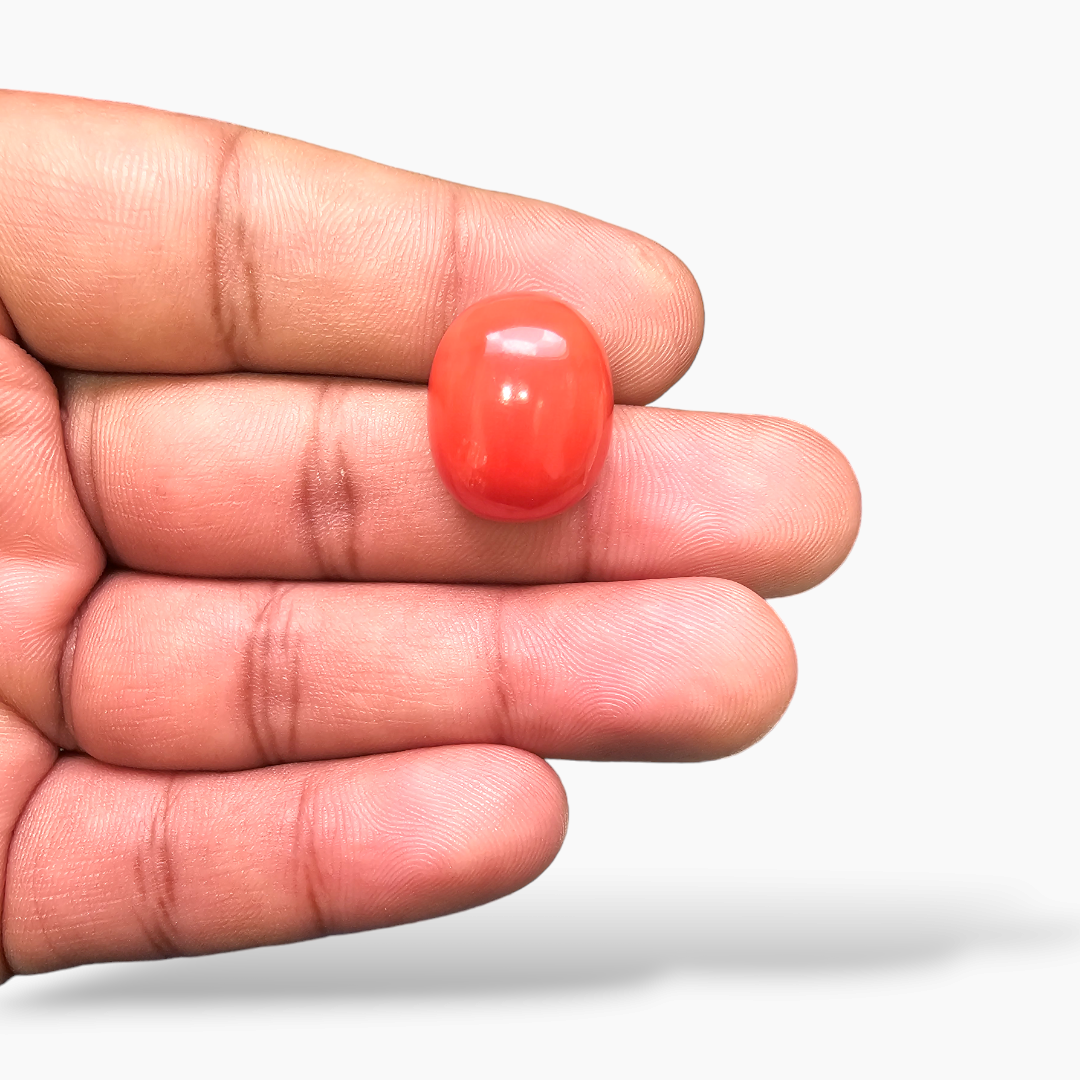
Not every gemstone comes from rock. Red coral is born in the ocean, built over hundreds of years by tiny sea animals called coral polyps. It is harvested from the sea, not mined like ruby or sapphire. You can see real stones in our red coral (Moonga) collection.
What Is Red Coral Stone?
An organic gemstone. Red coral is an organic gemstone, made by living things rather than by geology. Coral polyps build a hard calcium carbonate skeleton, and when that skeleton is cut and polished it becomes the gem we know.

Where the best coral comes from. The most prized red coral comes from the Mediterranean Sea, especially off Italy, Spain and Algeria. Japanese and Taiwanese coral are also highly valued.
Colour. Coral ranges from pale pink and salmon to deep, vivid red. You will also see white, orange and pink coral. The deeper and richer the red, the more valuable the stone.
Soft, so handle with care. Coral sits alongside pearl and amber as an organic gem. At 3 to 4 on the Mohs hardness scale, it is much softer than diamond or sapphire.
A Navaratna stone. In Vedic astrology, red coral is the stone of Mars (Mangal), the planet of energy, courage and ambition. It is one of the Navaratna, the nine precious gems of Vedic tradition.
Red Coral Stone Benefits in Tradition
The benefits below come from Vedic astrology, folk tradition and crystal beliefs. They are cultural ideas, not proven facts.
Protection from negative energy and the evil eye
Protection is the best-known coral belief. It is said to act like a shield around the wearer.
- Evil eye: worn against the evil eye, jealousy and the bad intentions of others.
- Black magic: said to guard against hexes and harmful spiritual influences.
- Home and personal space: kept nearby to clear negative energy.
- Travel: worn by travellers and warriors for protection from unseen dangers.
- Children: in some cultures, coral is a protective charm given to children.
Energy, drive and motivation
Mars is the planet of action, so red coral is linked with get-up-and-go.
- Believed to bring energy for long working hours and demanding goals.
- Linked with beating laziness and putting things off.
- Said to fuel ambition and focus.
Courage, confidence and fresh starts
- Thought to build courage, especially for people who fear failure or confrontation.
- Seen as a stone of fresh starts after setbacks, helping people rebuild confidence.
- Linked with strength, determination and the ability to keep going when things are hard.
- Said to help people clear old negativity and make space for new goals.
Love and relationships
- Believed to bring warmth and positivity to close relationships.
- Linked with better communication and fewer misunderstandings between partners.
- Said to help people show love more openly and keep friendships strong.
Many couples wear coral jewellery as a symbol of lasting love.
Good luck and success
Coral is a traditional good-luck stone. People link it with better decisions and success in work and business. In some cultures, people wear coral before big moments such as exams or job interviews.
Coral and Calm: Beliefs vs Facts
Many people search for coral because they have heard it brings calm. Here is what tradition says, and what the facts say.
Coral and calm in crystal traditions
- A symbol of calm: coral is linked with a relaxed, peaceful feeling and with emotional balance.
- Positive thinking: it is said to soak up negative energy and stand for hope and happiness.
- Night-time stone: some people keep coral close at night as a symbol of a calm, peaceful mind.
- Meditation: coral is often held during meditation as a focus for a clear mind.
- A link with nature: because it comes from the living sea, many wearers say it makes them feel connected to the natural world.
Can coral stone help anxiety, stress or heart health?
No. Coral is worn for beauty and tradition. It is not a medicine, and it does not treat anxiety, stress, heart problems or any other condition.
There is no scientific proof that coral stones improve blood circulation or heart health. For any health worry, please speak to a doctor.
Coral Colours and Their Meanings
Each coral colour carries its own meaning in crystal traditions:
- Red coral: energy, strength and courage.
- Pink coral: love, kindness and a calm, happy mood.
- White coral: peace, protection and positive energy.
- Orange coral: energy, creativity and success.
- Black coral: protection against evil and bad luck.
Some people choose a colour by their zodiac sign or birth chart. Others simply pick the one they find most beautiful.
Coral Through History
Coral has been treasured for thousands of years, from ancient Rome to the Mughal courts of South Asia.
- Egyptians: wore coral as a protection charm.
- Greeks and Romans: used it in jewellery and amulets.
- India and China: linked it with happiness and good fortune.
- Warriors and leaders: wore red coral as a stone of strength and courage.
For more, read coral stones in ancient Egyptian and Greek civilisations.
Types of Red Coral Stone
Not all coral is the same. Type and origin change both the look and the price.
Italian red coral (Corallium rubrum). Widely seen as the finest variety. It grows in the deep, cold Mediterranean waters off Sardinia, Sicily and the Italian Riviera. Expect a deep ox-blood red with a smooth, waxy lustre. It is the most expensive and most sought-after coral for fine jewellery and astrology.
Japanese red coral. Harvested from the Pacific around Japan and Taiwan. It is slightly lighter than Mediterranean coral but still a rich red, and it is the second most valued variety. It is popular in East Asian and South Asian jewellery.
Deep sea Mediterranean coral. From deeper Mediterranean waters, where depth and pressure create a denser stone with some of the most intense red colour. A premium choice for high-end jewellery and astrological rings.
Orange and salmon coral. Softer, warmer shades, popular in fashion and modern designs. Usually more affordable than deep red coral.
White coral (Safed Moonga). A related variety with its own place in astrology. It is linked with different planetary energies and is sometimes suggested for people who find red coral too strong.
Bamboo coral. A cheaper coral that is often dyed or treated to look red. It is common in fashion jewellery but is not considered suitable for astrological use. If you are buying coral for its traditional meaning, always ask whether it is natural and untreated.
Red Coral Stone Price Guide
Coral prices depend on variety, origin, colour, size, and whether the stone is natural or treated.
| Coral type | Price per carat | Best for |
|---|---|---|
| Italian red coral | $100 – $300 | Premium jewellery and astrology |
| Japanese red coral | $80 – $250 | Fine rings and pendants |
| Mediterranean coral | $60 – $200 | Luxury necklaces and bracelets |
| Deep red coral | $50 – $180 | Astrological rings |
| Orange / pink coral | $40 – $120 | Fashion and everyday jewellery |
| White coral (Safed) | $30 – $100 | Spiritual and traditional wear |
What pushes the price up:
- Colour depth: deeper red costs more.
- Surface: smooth, unblemished stones are worth more.
- Origin: Italian and Japanese coral command the highest prices.
- Natural or treated: a lot of coral on the market is dyed, bleached or treated to improve its colour. Natural, untreated coral with deep colour and good lustre is worth considerably more, and it is the kind preferred for traditional use.
Always ask for certification when you buy coral for astrology. All prices here are approximate market estimates and vary by seller, origin and quality.
Red Coral in Hindi and Urdu: Moonga and Marjan
Moonga in Hindi and Vedic astrology
In Hindi, red coral is Moonga (मूंगा). In Jyotish (Vedic astrology) it is the main gemstone of Mars (Mangal Graha). In this tradition, Moonga is believed to:
- Help clear debt and open the way to prosperity.
- Attract positive energy for wealth, business growth and career progress.
- Bring calm, clear thinking in difficult times.
- Remove obstacles, especially those linked to a weak or afflicted Mars in the birth chart.
- Build self-confidence, leadership and communication skills.
Vedic astrologers often suggest Moonga for people with Mangal Dosha, a Mars-related placement in the birth chart. This should always be checked by a qualified astrologer.
Marjan in Urdu and Islamic tradition
In Urdu, red coral is Marjan (مرجان). The word Marjan appears in the Quran (Surah Al-Rahman), and many scholars translate it as coral. This gives it a sacred significance in Islamic tradition.
- Linked with spirituality, purity of character and closeness to faith.
- Believed to bring politeness, gentleness and good behaviour.
- Associated with prosperity, especially in business, and with a clear, focused mind.
- Worn as a reminder of divine beauty and creation.
Marjan comes in white, orange and red, with red the most prized. It is popular in Pakistani, Iranian and Arab jewellery, often set in silver rings and worn every day.
Who Can Wear Red Coral Stone?
Because red coral is tied to Mars, astrologers match it to your birth chart and zodiac sign. People of all ages wear coral, from students to grandparents.
| Often recommended | Approach with caution |
|---|---|
| Aries (Mesh) | Taurus (Vrishabh) |
| Leo (Simha) | Gemini (Mithun) |
| Scorpio (Vrishchik) | Virgo (Kanya) |
| Sagittarius (Dhanu) | Libra (Tula) |
| Cancer (Kark) | Aquarius (Kumbh) |
| Pisces (Meen) | Capricorn (Makar) |
Aries and Scorpio come first. Both are ruled by Mars, so red coral is most strongly suggested for them. For other signs, it may still suit you, but ask a qualified Vedic astrologer to read your full birth chart first.
How to Wear Red Coral: Finger, Metal and Day
- Finger: the ring finger (Anamika) of the right hand is the traditional choice.
- Metal: gold is preferred. Copper is used in some traditions, and silver is common, especially for Marjan rings.
- Day: first put it on on a Tuesday morning, during the Mars hora. Many people do an energising ritual before wearing it.
- Weight: a minimum of 6 carats is generally suggested for astrological use. Your astrologer can advise on the right size for you.
- Timing: some people like to start wearing coral at an important moment, such as a new job or project.
Rings are the most common choice, but coral is also worn in necklaces, bracelets and earrings. For timings in detail, see the best day and time to wear coral stone.
Red Coral Side Effects: Things to Know
Astrological mismatch. In Vedic astrology, red coral is a strong stone. Astrologers say that for someone whose Mars is already strong and well placed, it can add too much Mars energy, showing up as aggression, impatience or acting on impulse. Always ask a Vedic astrologer before wearing it for planetary reasons.
Skin sensitivity. A few people get mild skin irritation from coral jewellery. This is usually caused by the metal setting, not the coral. If you notice redness or itching, stop wearing it and see a dermatologist.
For a full guide, read coral stone side effects: who shouldn't wear it and why.
How to Care for Red Coral Stone
Coral is soft and sensitive to chemicals and heat, so a little care goes a long way.
- Clean gently: use a soft, damp cloth. Never use chemical cleaners, ultrasonic machines or steam.
- Put it on last: perfume, hairspray, sunscreen and household chemicals can dull and discolour the surface.
- Keep it out of pools and the sea: long contact with water can affect the surface.
- Store it alone: keep it in a soft pouch, away from harder stones that can scratch it.
- Limit heat and sun: long exposure can fade the colour.
- Avoid knocks: coral can chip or crack if dropped on a hard floor.
Recharging, the traditional way. Some traditions suggest leaving coral under moonlight overnight, or rinsing it briefly under clean running water.
FAQs
How do I know if red coral is real?
Natural red coral has a smooth, waxy surface with fine grain lines you can see under magnification. It feels warm to the touch, unlike glass or plastic. Buy from a trusted jeweller and ask for a gem lab certificate confirming the stone is natural and untreated. For home checks, see how to check red coral stone authenticity.
Can women wear red coral?
Yes. Red coral is worn by both men and women. Astrologers often suggest it for women who want more confidence and inner strength, especially those born under Aries, Scorpio, Cancer, Leo, Sagittarius or Pisces.
How long does red coral take to show effects?
In Vedic tradition, gemstones are generally believed to start showing effects within 30 to 90 days of regular wear. The timing is said to depend on your birth chart and the quality of the stone.
Is red coral ethical to buy?
It is a fair question. Natural coral is protected in many parts of the world. Buy only from jewellers who can confirm their coral is legally and ethically sourced. Antique and vintage coral pieces are a good sustainable choice.
Gemstone traditions are cultural beliefs, not medical advice. See our gemstone and healing disclaimer.