

Feroza is turquoise — an opaque gem that ranges from sky blue to green. "Feroza" (also spelt Firoza) is its Urdu and Persian name, from the Persian word firuzeh.
In mineral terms it is a copper-aluminium phosphate. Copper gives the blue and iron pushes it towards green. It sits at about 5 to 6 on the Mohs hardness scale, so it is softer than quartz and needs gentle care.
The most famous Feroza comes from Iran, around Nishapur (Persian turquoise), and from Arizona in the USA. China and Egypt are important sources too. You can see real examples in our turquoise (Feroza) collection.
What is Feroza (Turquoise)?
A hydrous copper-aluminium phosphate. That is the scientific description of turquoise. It forms near the surface in copper-rich ground, where water slowly seeps through rock and leaves the mineral behind in veins and nuggets.
Why it comes from dry lands. This slow process needs arid conditions. That is why the main sources are dry regions: Iran, the American Southwest, parts of China, Egypt's Sinai, Chile and Australia.
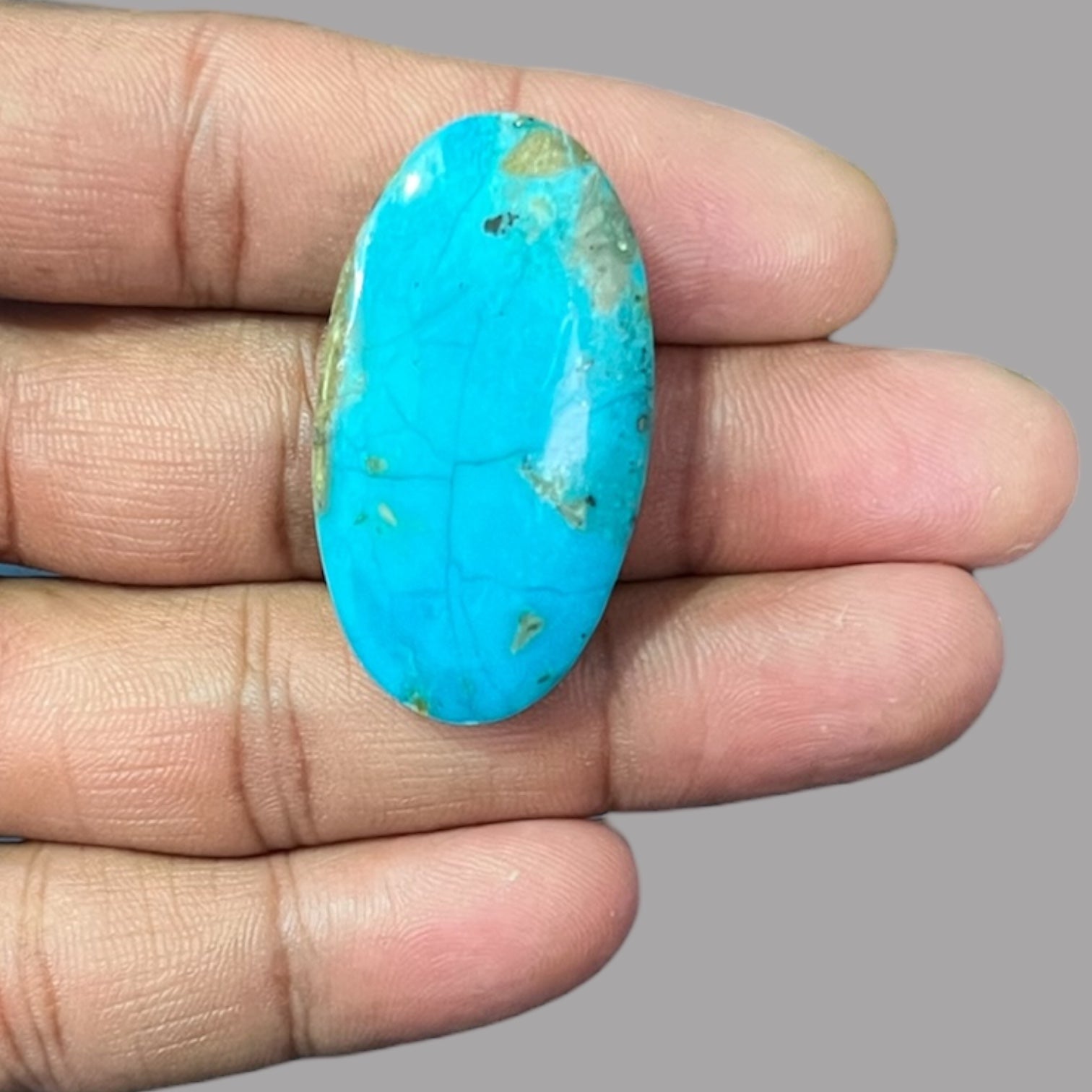
Opaque, not sparkly. Turquoise does not flash light like a sapphire. It has a smooth, waxy shine, so it is almost always cut as a cabochon — a rounded, polished dome — or shaped into beads and inlays.
Soft and porous. At 5 to 6 on the Mohs scale it can scratch and chip. It is also porous, so it can soak up oils, perfume and chemicals over time. That is why many stones on the market are stabilised, which we explain under price.
Feroza colours and what they mean
Every Feroza sits somewhere between blue and green. The balance of copper and iron in the stone decides where.
Sky blue (robin's egg blue)
The most prized colour. An even, vivid sky blue with no green and little or no matrix is the classic top grade. It is the look Persian turquoise and Arizona's Sleeping Beauty mine are famous for.
Blue-green
The most common shade. This is the colour most people picture when they hear the word turquoise. It looks good in both silver and gold.
Green
More iron, more green. Green turquoise has an earthy, natural feel. Tibetan turquoise often falls in this range.
Matrix and spider web
The dark veins are host rock. Brown, black or golden lines are the rock the turquoise grew in, called matrix. A fine, net-like pattern is called spider web, and good spider web stones are collected for their pattern alone.
Clean or veined is down to taste. Some buyers want a clean, even blue. Others love a bold matrix. Neither is wrong.
What the colour stands for. Across many cultures, the blue of turquoise is linked with sky and water, and so with calm, hope and truth. These are symbolic meanings passed down through tradition.
Persian vs American vs other origins
Origin changes the look, and it often changes the price. Here is how the main sources compare. For a closer look, read Iran vs USA: why Persian Feroza is still the most expensive.
Persian Feroza (Iran)
The classic name in Feroza. The mines near Nishapur, in north-east Iran, have been worked for many centuries. Fine Persian stones are known for an even sky blue with little or no matrix.
Ask where it was mined. In the trade, "Persian blue" is sometimes used as a colour description, not a guarantee of origin. If origin matters to you, ask the seller directly.
American Feroza (Arizona and the Southwest)
Arizona is the big name. The Sleeping Beauty mine gave a clean, bright blue that stood beside the best Persian stones. It stopped producing turquoise in 2012, so genuine Sleeping Beauty material is now harder to find.
Famous for matrix too. Other mines in Arizona, Nevada and New Mexico are known for bold matrix and spider web patterns.
China, Tibet, Egypt and others
China is one of the largest producers today, with colours from blue to green, often with matrix. Tibetan turquoise tends towards green.
Egypt has some of the oldest known turquoise mines, in the Sinai, worked by the ancient Egyptians thousands of years ago. Feroza is also found in Afghanistan, Mexico, Chile and Australia.
Feroza meaning and traditions
The ideas in this section are cultural beliefs and traditions, shared for interest. They are not proven facts.
Where the names come from
Feroza. From the Persian firuzeh, a word often linked with piruz, meaning victory. In Hindi it is written फ़िरोज़ा (Firoza).
Turquoise. From the old French for "Turkish stone". The gem reached Europe through Turkish trade routes, even though the finest stones came from Persia.
Why it is called the "stone of heaven"
It comes down to colour. A good Feroza looks like a clear sky, so many cultures linked it with the heavens. Persian, Egyptian and Native American stories all describe it as a sky stone in one form or another.
In the American Southwest, Navajo and Pueblo peoples treat turquoise as sacred and tie it to sky and water. It has been part of their ceremony, jewellery and trade for many centuries.
Luck and protection beliefs
- Evil eye: in Persian, Turkish, Arab and South Asian homes, Feroza is a traditional charm against the evil eye.
- Safe travel: warriors, riders and travellers once carried it for a safe journey.
- Good fortune: many people wear it as a lucky stone when starting a new job, business or trip.
- Truth and friendship: in Western crystal traditions it is linked with honest speech, loyal friendship and the throat chakra.
"It changed colour to warn me." An old belief says Feroza fades, changes colour or cracks when danger is near. The real reason is simpler: the stone is porous, so skin oils, perfume and sunlight can slowly shift its colour, and a hard knock can crack it.
Feroza in South Asian and Muslim culture
A favourite ring stone. In Pakistan, India, Iran and the Gulf, Feroza is one of the best-loved ring stones. It is a common gift for weddings, births and religious celebrations.
A reminder, not a promise. Many Muslims wear it as a cultural tradition and a reminder of blessing (barakah) and good company. Views on gemstones vary among scholars, so follow the guidance you trust.
Zodiac and birthstone links
December birthstone. Turquoise is one of the modern birthstones for December, alongside tanzanite and zircon.
Jupiter and Sagittarius. In South Asian astrology, Feroza is usually linked with Jupiter, and so with Sagittarius and Pisces. Some astrologers also suggest it for Aquarius.
Astrologers differ. Lists of "good" and "bad" signs change from one astrologer to the next. Feroza is generally seen as a gentle stone, but if you follow astrology, ask your own astrologer.
Who wears Feroza and how
Men, women and children all wear Feroza, and it suits everyday jewellery. These are the common traditions — follow the ones that matter to you.
Which finger
Ring finger, right hand is the most common choice in Pakistan and India. Some prefer the little finger, and some astrologers suggest the middle or index finger. There is no single rule.
Which metal
- Silver: the most traditional choice, and the usual pick for men.
- Gold: yellow gold warms the blue; white gold gives a cooler, modern look.
- Copper: seen in some American Southwest pieces for a rustic feel.
- Platinum: used in fine jewellery.
Which day
Thursday is the day many people first put on a Feroza ring, because Thursday is Jupiter's day in South Asian astrology. Some prefer Friday. This is tradition only.
Ring, pendant or bracelet
Rings are the most popular — usually a single square or oval stone in a plain or engraved frame. Pendants and lockets, often oval and sometimes framed with small diamonds or coloured stones, are a favourite with women. Beads and bracelets suit a casual look.
Feroza for men
A long tradition. Men's Feroza rings are especially popular in Pakistan, Iran, Afghanistan and the Gulf.
Silver is the norm. Gold is avoided for men in Islamic tradition, so most men's Feroza rings are set in silver.
Bigger, bolder stones. Men usually choose a larger square, oval or cushion cabochon in a strong, simple setting. Matrix and spider web stones suit a heavier silver ring well.
Everyday tip. If you wash your hands often, for example for wudu, quick contact with water is fine. Dry the ring afterwards and never soak it. Stabilised stones cope better with daily wear.
How to tell real Feroza from fake
Fake Feroza is common. The usual copies are dyed howlite or magnesite, plastic, glass, and "reconstituted" turquoise made from powder and resin.
- Too perfect, too cheap: a flawless, bright colour at a very low price is a warning sign.
- Dye in the cracks: colour pooling in the matrix lines can point to dyed stone.
- Ask what it is: natural, stabilised, dyed or reconstituted? A good seller will tell you plainly.
- Lab report: for a costly stone, ask for a gem lab report.
For seven simple checks you can do yourself, see Real vs fake Feroza: 7 easy ways to identify original turquoise.
Feroza price: what decides it
Feroza is one of the more affordable natural gemstones, but prices vary a lot. Six things decide what a stone is worth.
- Colour: even sky blue costs the most; green and patchy colour cost less.
- Matrix: clean stones usually cost more, though fine spider web can be valuable too.
- Origin: genuine Persian stones and material from closed American mines, like Sleeping Beauty, carry a premium.
- Treatment: fine untreated stones cost the most. Stabilised stones cost less, and dyed or reconstituted material less again.
- Hardness and polish: dense, hard turquoise takes a better shine and lasts longer than soft, chalky material.
- Size and cut: larger, well-shaped cabochons cost more per stone.
Rough price guide
| Type | Typical range | Notes |
|---|---|---|
| Persian turquoise | $80 – $300 per carat | Top grade, most prized |
| Sleeping Beauty (USA) | $50 – $200 per carat | Vivid, even blue |
| Tibetan turquoise | $20 – $120 per carat | Often green tones |
| Natural Feroza (loose) | $20 – $100 per stone | Mid-range, widely available |
| Treated turquoise | $5 – $40 per stone | Affordable, enhanced |
| Imitation | $1 – $10 per piece | Not real turquoise |
In Dubai, genuine Feroza at Raza Gems runs from roughly AED 70 to AED 400 per stone, depending on quality, size and origin. All figures here are approximate and move with the market.
Always ask about treatment. Stabilising with resin is common and accepted, but it should always be disclosed. Fine untreated turquoise is the rarest and costs the most.
How to care for Feroza
- Put it on last: after perfume, hairspray, lotion and make-up.
- Keep it dry: take it off before swimming, showering, the gym or housework. Chlorine and salt water are harsh on it.
- Clean gently: wipe with a soft, dry or barely damp cloth. No soaking, no soap.
- No machines: avoid ultrasonic and steam cleaners, which can damage the stone and any resin in it.
- Limit sun and heat: long exposure can fade or dry out some stones.
- Store it alone: keep it in a soft pouch, away from harder gems that can scratch it.
Going greener over time is normal. Natural, unstabilised Feroza can slowly turn greener as it absorbs skin oils. Some people like this aged look; if you don't, choose a stabilised stone. For more, read common mistakes that damage turquoise stones.
Feroza FAQ
Is Feroza the same as turquoise?
Yes. Feroza, or Firoza, is the Urdu, Persian and Hindi name for turquoise. It is the same mineral.
Is stabilised Feroza real turquoise?
Yes. It is real turquoise that has been hardened with resin to make it tougher and steadier in colour. It should be sold as stabilised and costs less than fine untreated stones.
Which is better, Persian or American Feroza?
Neither is better for everyone. Persian is famous for clean sky blue, while American stones are loved for both clean blue and bold matrix. Choose the colour and pattern you like.
Can I wear Feroza every day?
Yes, with a little care. Take it off for water, sport, cleaning and perfume, and a bezel setting will help protect its edges.
Is Feroza expensive?
Most Feroza is affordable. Top-grade untreated Persian stones and rare American material cost much more, depending on colour, origin and treatment.