
Carat vs Size: Why Gem Weight Is Not Size
A carat measures weight, not size, so a 1 carat ruby looks smaller than a 1 carat emerald. See approximate mm sizes for a 1 carat round of common gems.
On this page
Carat vs size is simple once you know one fact: a carat measures weight, not size. One carat equals 0.2 grams. Two gems of the same carat weight can look very different in size, because some gem materials are heavier than others.
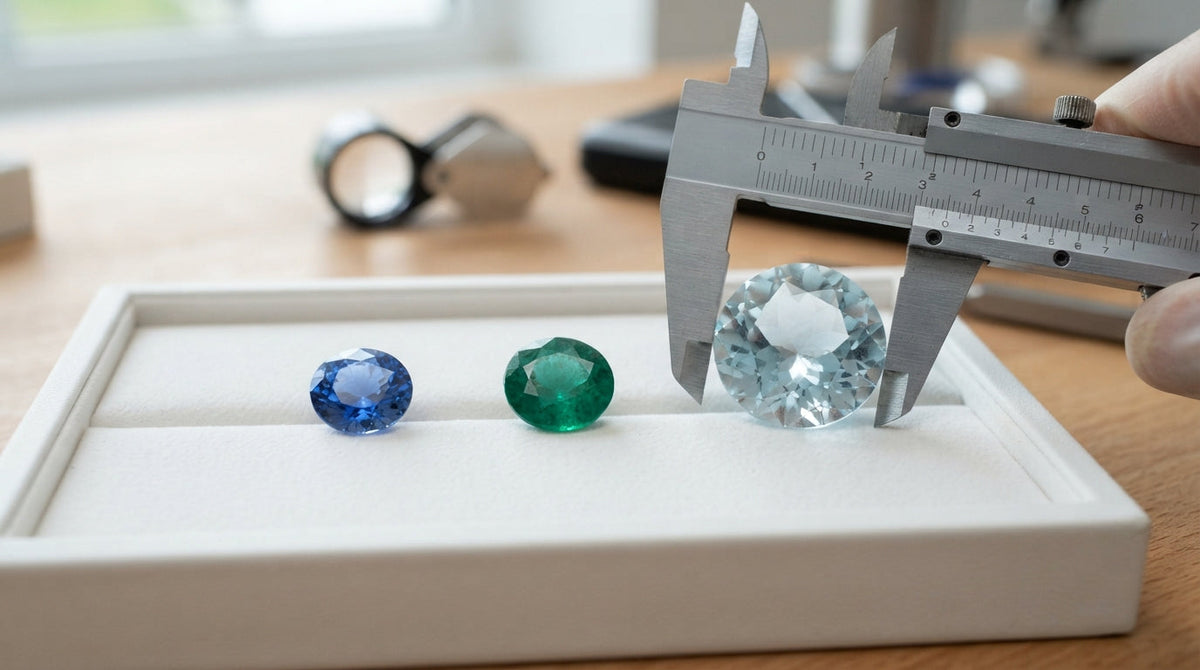
So a 1 ct ruby looks smaller than a 1 ct emerald. If size matters to you, ask for the measurements in millimetres, not just the carat weight.
A carat is a unit of weight
The carat is the standard weight unit for gemstones worldwide. One carat is exactly 0.2 grams, so five carats make one gram. You can read more about the history of the carat.
- Points: one carat is split into 100 points. A 0.50 ct stone is a "50-pointer".
- Not karat: karat (K) measures the purity of gold, such as 18K. It has nothing to do with stone weight.
- Other units: in South Asia, ratti is still used. See our carat, gram, tola and ratti guide.
Carat vs size: why the same weight looks different
Size is what you see: the length, width and depth of the stone in millimetres. Three things decide how big a stone of a given weight looks.
1. Density (specific gravity)
Every gem material has its own density. Gemmologists call it specific gravity, or SG. It compares the stone's weight with the same volume of water.
A gem with a high SG packs more weight into a small space. A gem with a low SG takes up more space for the same weight.
- Ruby and sapphire: SG about 4.00. Heavy, so a 1 ct stone is fairly small.
- Emerald: SG about 2.72. Light, so a 1 ct stone is noticeably larger.
- The result: a ruby of the same size and cut as an emerald weighs about one and a half times as much.
2. Cut proportions
Two stones of the same gem and weight can still look different. It depends on how the weight is spread.
- Deep cut: much of the weight sits in the bottom (pavilion). The stone looks smaller from the top.
- Shallow cut: the stone looks wider, but it may show a dull "window" in the centre.
- Well cut: a good balance of face-up size and brightness.
3. Shape
Long shapes spread weight over a bigger face-up area. An oval, pear or marquise usually looks larger than a round of the same weight. A cushion or round looks more compact.
Specific gravity of common gemstones
Here are widely published approximate SG values for popular gems. Some gems, like garnet and tourmaline, vary because they come in different types.
| Gemstone | Approx. specific gravity |
|---|---|
| Zircon | about 4.6 to 4.7 |
| Ruby and sapphire (corundum) | about 4.00 |
| Garnet (depends on type) | about 3.6 to 4.3 |
| Spinel | about 3.60 |
| Topaz | about 3.53 |
| Diamond | about 3.52 |
| Tanzanite | about 3.35 |
| Peridot | about 3.34 |
| Tourmaline | about 3.06 |
| Emerald and aquamarine (beryl) | about 2.72 |
| Amethyst and citrine (quartz) | about 2.65 |
For a wider explanation of the idea, see specific gravity on Wikipedia.
Approximate mm size of a 1 carat round gemstone
The table below shows roughly how wide a 1 ct round stone of each gem would be. These are approximate figures only.
They start from a well-cut 1 ct round diamond, which is about 6.4 to 6.5 mm across. They are then adjusted for each gem's density. Coloured stones are often cut deeper than diamonds, so a real stone may be a little smaller than shown.
| Gemstone (1 ct round) | Approx. diameter |
|---|---|
| Zircon | about 5.7 to 5.9 mm |
| Ruby / sapphire | about 6.0 to 6.2 mm |
| Garnet | about 5.9 to 6.4 mm |
| Spinel | about 6.2 to 6.4 mm |
| Topaz | about 6.3 to 6.5 mm |
| Diamond | about 6.4 to 6.5 mm |
| Tanzanite / peridot | about 6.4 to 6.6 mm |
| Tourmaline | about 6.6 to 6.8 mm |
| Emerald / aquamarine | about 6.9 to 7.1 mm |
| Amethyst / citrine | about 6.9 to 7.2 mm |
The gap looks small on paper, but you can see it in a ring. A 7 mm stone looks clearly bigger than a 6 mm stone on the finger.
Double the weight is not double the size
This surprises many buyers. Weight grows with volume, which grows in three directions at once.
- Width: a 2 ct stone is only about 26% wider than a 1 ct stone of the same gem and cut.
- Face-up area: the top surface is roughly 60% larger, not twice as large.
- The other way round: doubling the width of a stone means about eight times the weight.
So if you want a stone that "looks bigger", a small jump in mm can mean a big jump in carats and price.
How to estimate carat weight from mm
Jewellers weigh loose stones on a carat scale. That is the only accurate method.
For a stone already set in jewellery, gemmologists use estimation formulas. For a round stone, a common rough formula is:
diameter × diameter × depth (all in mm) × SG × 0.0018 ≈ carat weight
For example, a round diamond of 6.5 mm wide and 3.9 mm deep comes out at about 1.04 ct. Treat this as a guide only, because the girdle and pavilion shape change the real result.
Common mistakes buyers make
Most size surprises come from a few simple mix-ups. Here are the ones we see most often.
- Comparing carats across gems: a 1 ct emerald and a 1 ct sapphire are not the same size. Compare millimetres instead.
- Thinking heavier means bigger: a deep-cut stone can weigh more but look smaller from the top.
- Mixing up carat and karat: "18K" in a jewellery listing is about the gold, not the stone.
- Judging size from photos: close-up photos hide the real scale. Ask for the mm size, or a photo next to a ruler.
- Missing "total carat weight": some listings add up every stone in a piece. The centre stone may be much smaller than the total suggests.
Practical tips when buying by size
- Ask for measurements: always get length, width and depth in mm, not just the weight.
- Compare face-up size: two stones of the same weight can look very different from the top.
- Watch out for deep stones: extra depth adds carats and price without adding visible size.
- Choose calibrated sizes for settings: standard sizes like 6×4 mm or 8×6 mm oval fit ready-made mounts.
- Think about the jewellery: a ring, pendant and earring each suit a different size. A custom piece can be built around your stone.
Browse stones by weight in our under 1 carat and 1 to 2 carat collections. If you need many stones in one size, see our calibrated gemstone lots. For a ring or pendant made around your stone, look at our custom orders page.
Buying online? Our guide to buying gemstone jewellery online covers what else to check.
FAQs
Is carat the size of a gemstone?
No. Carat is weight, and one carat equals 0.2 grams. Size is measured in millimetres.
Why does a 1 carat ruby look smaller than a 1 carat emerald?
Ruby is denser than emerald. The same weight of ruby takes up less space, so it looks smaller.
How big is a 1 carat sapphire in mm?
A 1 ct round sapphire is roughly 6.0 to 6.2 mm across. The exact size depends on how deep it is cut.
Is a 2 carat stone twice as big as a 1 carat stone?
No. A 2 ct stone is only about a quarter wider than a 1 ct stone of the same gem and cut. Its face-up area is roughly 60% larger.
What is the difference between carat and karat?
Carat measures gemstone weight. Karat measures gold purity, such as 18K or 22K.
Keep reading

Ready to find your stone?
Natural gemstones and jewellery from our Dubai showrooms, shipped worldwide with tracking.