
Gemstone Price Per Carat Explained
Price per carat times weight gives the total price of a gemstone. Learn why two stones of the same weight can cost very different amounts, and how to compare offers fairly.
On this page
Gemstone price per carat is the price for each carat of weight. You multiply it by the stone's weight to get the total price. Two stones of the same weight can differ a lot in price per carat, because colour, clarity, cut, origin, treatment and size all change it.
This guide explains each factor in simple terms. By the end you will know how to compare two stones fairly and spot common pricing traps.
How gemstone price per carat works
Gem dealers quote most loose stones per carat. It makes it easy to compare stones of different sizes.
The maths is simple: total price = price per carat × weight in carats.
- Example: a 2.50 ct stone at 100 per carat (in any currency) costs 2.50 × 100 = 250.
- The trap: some listings show only the per-carat figure in large print. Always work out the total before you get excited.
- Weight units: in South Asia you may also hear ratti. Our carat, gram, tola and ratti guide explains the difference.
Why two stones of the same weight cost different prices
Imagine two 2-carat sapphires side by side. One may cost many times more per carat than the other. Here is why.
1. Colour
For most coloured gems, colour is the single biggest price factor. Gemmologists look at three things.
- Hue: the main colour, such as red, blue or green, and any secondary tint.
- Tone: how light or dark it is. Too light looks washed out, too dark looks black.
- Saturation: how strong and pure the colour is. Strong, even colour costs the most.
Small shifts matter. A ruby with a pure red colour usually costs more per carat than one with an orange or brownish tint.
2. Clarity
Clarity is about inclusions, the tiny features inside a stone. What counts as "good" depends on the gem.
- Usually clean: stones like aquamarine, topaz and citrine are often eye-clean, so visible inclusions lower the price sharply.
- Usually included: emerald almost always has inclusions, so buyers accept more. Our guide on choosing a quality emerald covers this.
- Durability: inclusions that reach the surface or weaken the stone hurt value more than tiny internal ones.
3. Cut
A good cut shows off colour and brightness. A poor cut can make an expensive gem look dull.
- Windows: a stone cut too shallow lets light pass straight through. You see a pale "window" in the centre.
- Extinction: dark areas that do not sparkle, often from poor angles.
- Hidden weight: some stones are cut deep to keep carats. You pay for weight that sits under the stone and does not show face-up.
A well-cut stone may weigh less but look larger and brighter. That is why its price per carat is often higher.
4. Origin
Certain sources carry a premium because of their history and reputation. Well-known examples include rubies from Burma (Myanmar), sapphires from Kashmir and emeralds from Colombia.
That premium only makes sense with a lab report that gives an origin opinion. Without one, origin is just a seller's claim. Read more in our ruby origin guide.
5. Treatment
Treatment can change price per carat more than almost anything else.
- Unheated: natural colour with no heating, confirmed by a lab. Usually the highest price per carat.
- Heated: common and widely accepted for ruby and sapphire. Priced below unheated stones of the same look.
- Heavy treatments: glass filling or diffusion lower the price much further.
Our article on heated vs unheated ruby shows how this works in practice.
6. Size jumps
Here is the part many buyers do not expect. Price per carat usually rises as stones get bigger, because large fine stones are rarer.
- Not linear: a 4 ct stone usually costs more than twice a 2 ct stone of the same quality.
- Weight thresholds: prices often step up at round weights such as 1, 2, 3 and 5 carats.
- Smart buying: a stone just under a threshold, like 0.95 ct, can cost noticeably less than 1.00 ct, with almost no visible size difference.
The size of these jumps depends on the gem. For common stones like amethyst, the jump is small. For ruby and sapphire, it can be large.
7. Other factors
- Rarity of the gem type: some gems are simply rarer than others, whatever the quality.
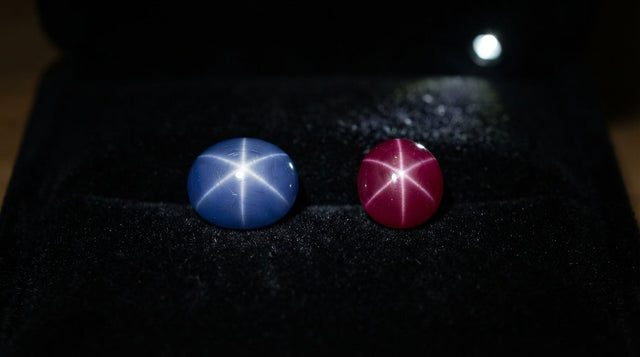
- Special effects: a sharp star, a clear cat's eye or a strong colour change adds value.
- Matched pairs: two stones that match well for earrings often cost more per carat than two single stones.
- Lab report: a reliable report removes doubt, which buyers are willing to pay for.
Gemstone lots: price per carat for many stones
Jewellers often buy small stones in lots. A lot is a group of stones sold together, usually priced per carat for the total weight.
- Calibrated lots: stones cut to standard sizes, such as 4 mm round or 6×4 mm oval, so they fit ready-made settings.
- Check the total weight: the price is per carat times the lot's total weight, not per piece.
- Check consistency: colour and size should match across the lot. A few odd stones lower its real value.
- Smaller stones cost less per carat: small stones are easier to find, so their per-carat price is usually lower than a single large stone of the same quality.
You can browse our calibrated gemstone lots, or see our wholesale page if you buy for a business.
How to compare gemstone prices fairly
Use this simple checklist when you compare two offers.
- Same gem, same treatment: compare heated with heated and unheated with unheated.
- Similar weight: compare within the same weight band, for example 1 to 2 carats.
- Same type of report: a stone with a reliable lab report is not the same offer as one without.
- Look at colour in real light: photos and screens can flatter a stone.
- Work out the total price: multiply per carat by weight yourself.
- Check return terms: a fair return window lets you get a second opinion.
Common gemstone pricing traps
- "Cheap" big stones: a very low price per carat on a large ruby or sapphire often means heavy treatment or synthetic material.
- Origin without proof: a famous origin name with no lab report behind it.
- Deep cuts: a heavy stone that looks small face-up. You pay for hidden weight.
- Per-carat bait: a low per-carat price on a low-grade stone, compared with a high per-carat price on a fine stone.
Ask for the lab report and the exact weight before you agree a price. For more detail on one gem, see our guide to what drives ruby value. GIA's ruby quality factors page is another good, independent read.
FAQs
How do I calculate the total price of a gemstone?
Multiply the price per carat by the weight in carats. A 1.80 ct stone at 100 per carat costs 180 in the same currency.
Why is a 2-carat stone more than double the price of a 1-carat stone?
Larger fine stones are rarer, so the price per carat rises with size. You pay more per carat as well as for more carats.
Which matters more for price, colour or clarity?
For most coloured gems, colour matters most. Clarity matters more in gems that are normally clean, such as aquamarine and topaz.
Are gemstone lots cheaper per carat?
Usually, yes. Small calibrated stones are easier to find than one large stone, so the per-carat price is often lower.
Does a lab report increase the price of a gemstone?
A reliable report does not change the stone, but it removes doubt about what you are buying. That confidence is often reflected in the price.
Keep reading

Ready to find your stone?
Natural gemstones and jewellery from our Dubai showrooms, shipped worldwide with tracking.