
How to Read a Gemstone Lab Report
A gemstone lab report tells you what a stone is, whether it is natural or synthetic, and how it was treated. Here is how to read each part and verify the report number.
On this page
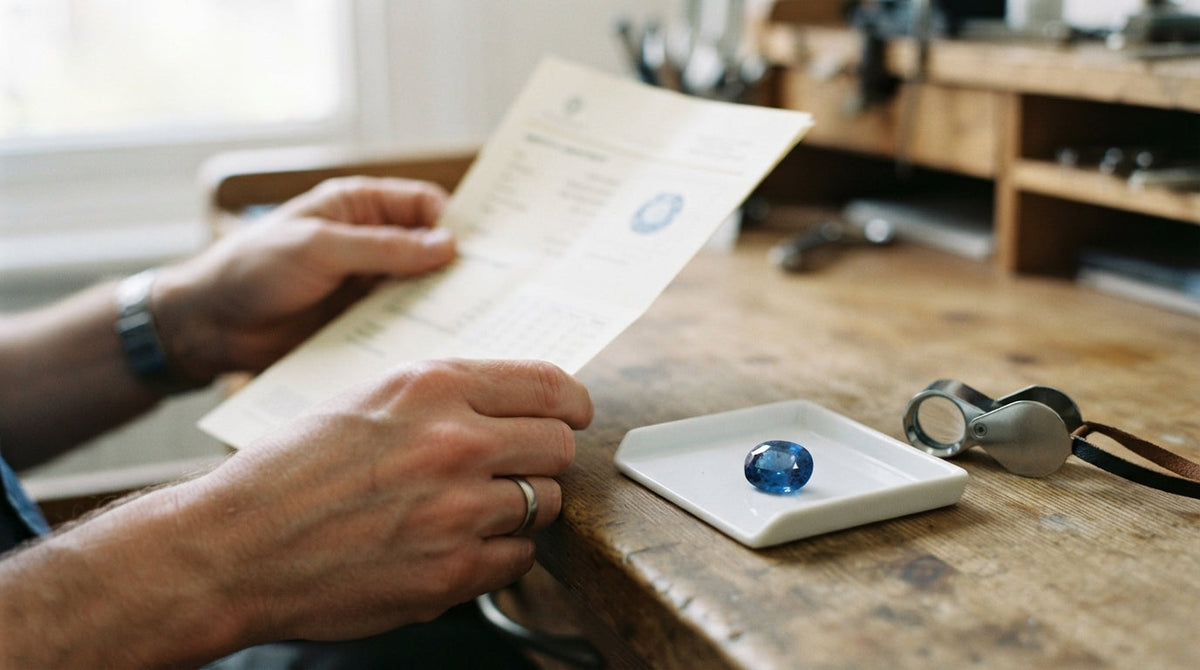
A gemstone lab report tells you what your stone is, whether it is natural or synthetic, and whether it has been treated. Some reports also give an opinion on where the stone came from. It does not tell you what the stone is worth.
Read it in a set order: the stone's identity first, then natural or synthetic, then treatment, then origin. This guide walks you through each part in plain English, so you can read any report with confidence.
What a gemstone lab report actually is
A lab report is an independent laboratory's written opinion of a stone, based on tests done on the day it was examined. Gemmologists use microscopes, spectroscopy and other instruments to reach their conclusions.
People often call it a "certificate", but most labs prefer the word "report". That is because it records findings. It is not a guarantee of value or quality.
You will see reports from many labs. International names include GIA, GRS and SSEF. In this region you will also see reports from labs such as IDL and CGL. The layout changes from lab to lab, but the main sections are very similar.
The basic details: weight, size, shape and colour
The top of most reports describes the stone so it can be matched to the report. Check these lines against the stone in front of you.
- Report number and date: the unique ID you use to verify the report. The date matters too, because a stone can be recut or treated after testing.
- Weight: given in carats, usually to two decimal places (for example 2.47 ct).
- Measurements: length, width and depth in millimetres. These are a second way to match the stone.
- Shape and cutting style: such as oval, cushion, cabochon, or "modified brilliant".
- Colour: a description such as "red", "purplish red" or "blue".
- Transparency: transparent, translucent or opaque.
- Photo: most reports carry a picture of the stone. It helps, but colour on paper is never exact.
Identification: species and variety
This is the most important line on the report. It tells you what the stone is in gemmological terms.
Labs often name two things. The species is the mineral family, and the variety is the trade name you know.
- Corundum: the variety is ruby (red) or sapphire (other colours).
- Beryl: the variety is emerald (green) or aquamarine (blue).
- Zoisite: the blue to violet variety is tanzanite.
- Chrysoberyl: varieties include alexandrite and cat's eye.
Watch the wording closely. A report that only says "natural gemstone" without naming the species tells you very little.
Natural, synthetic or imitation
After identity, the report states whether the stone formed in nature. These three words are often mixed up, so here is what each one means.
| Term on report | What it means |
|---|---|
| Natural | Formed in the earth. Cutting and polishing do not change this. |
| Synthetic / laboratory-grown | Made in a factory with the same chemistry as the natural stone. It is real corundum or beryl, but not natural. |
| Imitation / simulant | A different material that only looks similar, such as glass or a different gem. |
| Assembled / composite | Made of more than one piece or material, such as a doublet, or a stone heavily filled with glass. |
Synthetic stones are not "fake" in a chemical sense, but they are worth far less than natural ones. If you want to know more, read our guide on the impact of lab-grown gemstones.
Treatment: the line that moves the price most
Many natural gems are treated to improve colour or clarity. This is normal in the trade, but it must be disclosed, and it changes value a lot.
Common treatment wording
- "No indications of heating" or "no evidence of thermal treatment": the lab found no signs that the stone was heated. Unheated rubies and sapphires usually sell at a premium.
- "Indications of heating" or "heated": the stone was heated to improve colour or clarity. This is very common in ruby and sapphire.
- Heating with residues: some reports note small amounts of residue in fissures after heating. Labs may grade how much.
- Clarity enhancement (emerald): oil or resin in fractures. Many labs describe the amount with words like none, minor, moderate or significant.
- Lead-glass filling: glass fills large fractures, mostly in low-grade ruby. Some labs call heavily filled stones a composite rather than plain ruby.
- Diffusion: colour added from outside the stone with chemicals and heat, for example beryllium in sapphire.
- Irradiation: used on some stones, such as blue topaz, to create or change colour.
Some labs use short codes instead of full words. Always read the key, which is usually printed on the back of the report.
What "no treatment detected" does not mean
Some treatments are so routine that labs cannot always prove whether they were done. Tanzanite, for example, is almost always heated, and heating is usually impossible to detect.
So a lab may comment that treatment is common for that gem. That is honest reporting, not a red flag. For a practical example, see heated vs unheated Mozambique ruby.
Origin: an expert opinion, not a fact
Some labs, such as GRS and SSEF, offer an origin opinion as an extra service. The report might say the stone's features match those of rubies from Burma (Myanmar) or Mozambique, for example.
Labs reach this view from inclusions, trace elements and other data. It is a well-informed opinion, and it is not a certainty.
- Labs can disagree: two respected labs may give different origins for the same stone.
- Some stones get no origin: the report may say origin could not be determined. That is normal.
- Origin changes value: famous sources carry a premium, so this line deserves close attention.
Our guide to ruby origins explains why buyers care so much about it.
Colour terms: "pigeon's blood", "royal blue" and others
Some labs add a trade colour name to their reports. Common examples are "pigeon's blood" for ruby and "royal blue" or "cornflower blue" for sapphire.
These names suggest a top colour. But each lab sets its own rules for when to use them.
- Not a shared standard: a "royal blue" from one lab is not always the same as from another.
- Check which lab: a trade name only means something alongside the lab that issued it.
- Trust your eyes too: look at the stone in daylight and indoor light, not just at the words.
Other labs, including GIA, describe colour in plain words such as hue and saturation, without trade names.
How to verify a report number
Fake and altered reports exist. Checking one takes a few minutes, so do it before you pay for any important stone.
- Find the report number: it is printed on the report, often with a QR code.
- Go to the lab's own website: type the address yourself. Do not trust a link or QR code sent by the seller alone.
- Enter the number: many labs have an online check. GIA explains its Report Check service and the security features on its reports.
- Compare every detail: weight, measurements, shape, colour and treatment should match the paper exactly.
- Compare the stone itself: weigh it on a carat scale and measure it if you can. A different weight means a different stone, or a recut one.
- Contact the lab if unsure: if there is no online check, email the lab with the report number.
Red flags to watch for
- A "lab" you cannot find: no website, no address, no way to check reports.
- A seller's own certificate: a document printed by the shop selling the stone is not independent.
- Vague wording: "genuine gemstone" with no species, treatment or measurements.
- An old report on a valuable stone: ask whether it has been recut or re-treated since.
Lab report vs appraisal
These two documents do different jobs. Mixing them up is one of the most common buyer mistakes.
| Lab report | Appraisal / valuation | |
|---|---|---|
| Who issues it | An independent gem laboratory | An appraiser or valuer, sometimes the seller |
| What it covers | Identity, natural or synthetic, treatment, sometimes origin | An estimated money value |
| Shows a price? | No | Yes |
| Main use | Knowing exactly what you are buying | Insurance, or estate and resale planning |
An appraisal figure can be high or low depending on its purpose. Always see the lab report first, because the value depends on what the stone actually is.
Which lab should you trust?
There is no single "best" lab for every stone. What matters is that the lab is independent, well known, and that its reports can be checked.
- High-value stones: for a fine ruby, sapphire or emerald that you may resell abroad, buyers often prefer a report from a lab well known in that market.
- Everyday stones: a report from a recognised regional lab is often enough to confirm identity and treatment.
- Second opinions: for an expensive stone, a second report from another lab is a sensible safety check.
Ask the seller for the report before you buy. At Raza Gems we show the lab report on major stones, and you can browse our GRS-reported stones or read more about the labs we work with. For other checks you can do yourself, see our gemstone authentication guide.
FAQs
Is a gemstone certificate the same as a lab report?
In everyday speech, yes. Most labs call their document a "report" because it records findings. It does not certify value.
Does a lab report show the value of a gemstone?
No. A lab report covers identity, treatment and sometimes origin. For a money value, you need a separate appraisal.
Can a gemstone lab report be fake?
Yes, fake and altered reports exist. Always check the report number on the lab's own website and compare the weight and measurements with the stone.
Why do two labs give different origins for the same stone?
Origin is an expert opinion based on inclusions and chemistry. Data from some mines overlap, so respected labs can reach different conclusions.
Does "heated" mean my ruby or sapphire is bad?
Not at all. Heating is a common, stable treatment in ruby and sapphire. It usually lowers the price compared with an unheated stone of the same quality, but it is widely accepted in the trade.
Keep reading

Ready to find your stone?
Natural gemstones and jewellery from our Dubai showrooms, shipped worldwide with tracking.